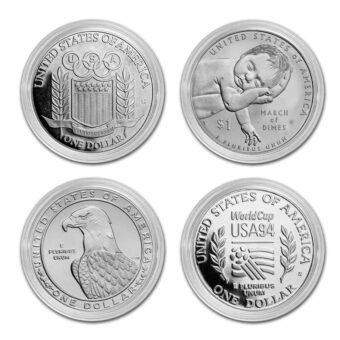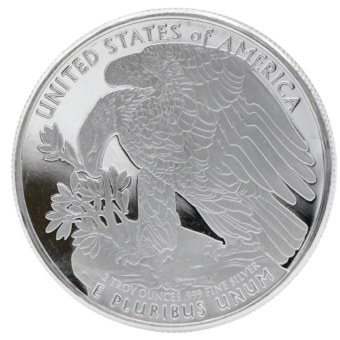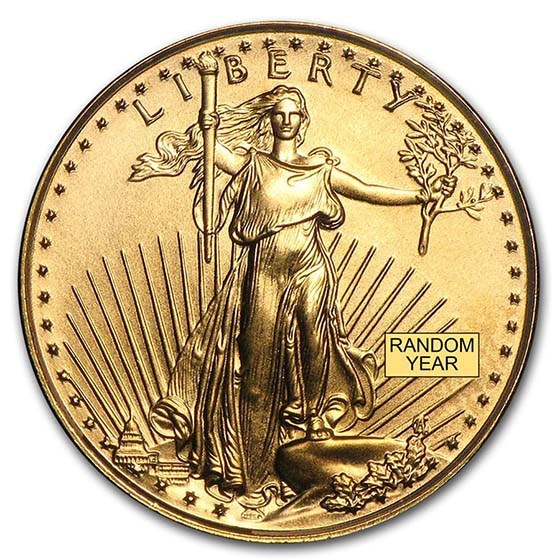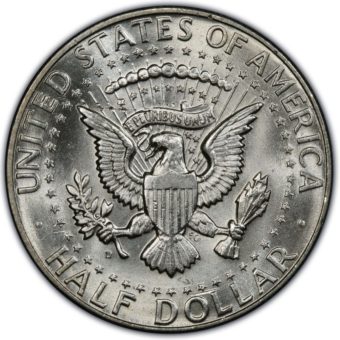

In a week defined by sharp reversals and competing narratives, one truth stood firm: markets remain highly sensitive to currency strength, central bank policy, and geopolitical developments. While gold and silver were pulled in multiple directions, the broader signal is becoming clearer—structural shifts in the global monetary system continue to build. For those focused on preserving long-term purchasing power, this environment demands attention, not reaction.
Weekly Market Recap
Monday (4.13.26)
Gold and silver opened the week under pressure as U.S.–Iran tensions escalated, lifting oil prices and strengthening the dollar. June gold fell to $4,731, while silver dropped to $74.03. Rising energy costs reinforced inflation concerns, reducing expectations for near-term rate cuts. In this environment, a stronger dollar tends to weigh on precious metals.
Tuesday (4.14.26)
Markets quickly reversed course. A weaker U.S. dollar supported a strong rebound in metals, with gold climbing to $4,831 and silver to $79.27. Even cooler-than-expected producer inflation data failed to shift sentiment significantly—currency movement remained the dominant driver.
Wednesday (4.15.26)
Midweek trading turned uneven. Gold eased slightly while silver held firm after both reached multi-week highs. The dollar continued to soften, providing underlying support. Despite short-term volatility, the broader trend of currency weakness continues to support long-term demand for tangible assets.
Thursday (4.16.26)
Markets paused. Gold stabilized near $4,830 while silver consolidated just below $80. Rising yields and a firmer dollar limited upside momentum. Key technical levels are now in focus, with gold eyeing $5,000 resistance and $4,500 support.
Friday (4.17.26)
Gold and silver edged higher in calmer trading, with June gold at $4,814.40 and May silver at $79.38, as easing Middle East tensions and improving ceasefire prospects reduced volatility. Progress in U.S.–Iran talks and a regional truce helped stabilize sentiment, while mild technical buying supported prices. The takeaway: metals are shifting from reactive swings to more stable footing as geopolitical pressures ease.
Friday Macro Briefing
Dollar’s Global Share Continues to Decline
The Big Picture
The U.S. dollar remains dominant—but its share in global reserves and transactions continues to trend lower as central banks diversify.
Driving the News
Recent data shows a steady decline in dollar usage alongside increased gold accumulation by central banks and growing adoption of alternative currencies.
By the Numbers
- 46% — current share of global FX and gold reserves
• -15 points — decline since 2017
• 57% — share of reserves (excluding gold)
• 1994 — last comparable reserve level
• 1990–91 — last time USD fell below 50%
Why It Matters
A gradual shift away from dollar dependence reflects changing global priorities. Nations are seeking diversification, stability, and reduced exposure to any single currency system.
What to Watch
- Central bank gold purchases
• Expansion of non-dollar trade
• Reserve diversification trends
• Geopolitical influences on currency strategy
The Bottom Line
The dollar remains central—but its relative dominance is slowly evolving. Gold continues to play a growing role in global reserves.
Gold Holds Steady as Labor Market Strength Persists
The Big Picture
Gold remains supported above $4,800, though upward momentum has slowed.
Driving the News
Stronger-than-expected jobless claims data signals continued labor market resilience, reducing urgency for defensive positioning.
By the Numbers
- $4,800 — key support level
• $4,815.80 — latest price
• 207,000 — jobless claims
• 213,000 — forecast
• 1.818 million — continuing claims
Why It Matters
A strong labor market can delay monetary easing, which often tempers gold’s short-term upside.
What to Watch
- Labor market trends
• Federal Reserve policy outlook
• Real yields
• Broader economic momentum
The Bottom Line
Gold is stable but waiting. A clearer macro catalyst will determine the next move.
BRICS Expansion Signals Global Economic Realignment
The Big Picture
BRICS nations now represent a larger share of global GDP (PPP) than the G7, marking a meaningful shift in economic influence.
Driving the News
Stronger growth, resource control, and increased non-dollar trade have accelerated this transition.
By the Numbers
- 40% — BRICS share of global GDP
• 28–29% — G7 share
• 3.7% — BRICS growth rate
• 1.1% — G7 growth rate
• $1T+ — non-dollar trade
Why It Matters
Economic power is becoming more distributed globally, with reduced reliance on the U.S. dollar in trade settlements.
What to Watch
- Growth divergence
• Alternative payment systems
• Commodity trade flows
• Currency diversification
The Bottom Line
A multipolar system is emerging—one where gold and hard assets play a more neutral role across borders.
Federal Tax Dominance Highlights Centralized Fiscal Power
The Big Picture
Federal tax collection significantly outweighs state and local levels.
Driving the News
Recent data underscores the scale and concentration of federal revenue.
By the Numbers
- $5.1T — federal tax revenue
• $2.5T — state + local combined
• 60%+ — share from federal sources
Why It Matters
Centralized fiscal systems influence policy direction, spending priorities, and long-term economic stability.
What to Watch
- Federal spending trends
• Deficit levels
• Tax policy shifts
The Bottom Line
Fiscal centralization remains a defining feature of the U.S. system.
Silver Gains Momentum as Demand Strengthens
The Big Picture
Silver is regaining strength, supported by both industrial and investment demand.
Driving the News
Rising energy prices, geopolitical uncertainty, and strong solar demand are supporting prices.
By the Numbers
- ~$79–$80 — current price
• ~$70 — recent low
• ~$100+ — near-term target
• ~19% — solar demand share
Why It Matters
Silver’s dual role—industrial and monetary—positions it uniquely during periods of economic transition.
What to Watch
- Industrial demand trends
• Energy markets
• Supply constraints
• Investment flows
The Bottom Line
Silver’s outlook is strengthening, particularly as global demand continues to expand.
Next Week’s Key Events
Economic Calendar: April 20 – April 24, 2026
Monday
• No major events
Tuesday
• 8:30 am — Retail Sales
• 10:00 am — Leading Indicators
• 10:00 am — Pending Home Sales
Wednesday
• No major events
Thursday
• 8:30 am — Jobless Claims
• 9:45 am — Services PMI
• 9:45 am — Manufacturing PMI
Friday
• 10:00 am — Consumer Sentiment
Impact on Precious Metals
Retail Sales
• Strong → Economic resilience; modest pressure on metals
• Weak → Slowing demand; supportive for metals
Consumer spending drives growth expectations and inflation outlook.
Leading Indicators
• Rising → Signals expansion; neutral-to-bearish
• Falling → Signals slowdown; supportive
Forward-looking measure of economic direction.
Housing Data
• Strong → Confidence; mild pressure
• Weak → Caution; mild support
Interest-rate sensitive sector.
Jobless Claims
• Rising → Labor softening; supportive
• Falling → Continued strength; modest pressure
High-frequency economic signal.
PMIs (Services & Manufacturing)
• Strong → Expansion; pressure on metals
• Weak → Contraction risk; supportive
Key indicators of business activity.
Consumer Sentiment
• High → Confidence; mild pressure
• Low → Concern; supportive
Impacts spending behavior and outlook.
Final Thoughts
Short-term volatility may come and go, but the broader direction is increasingly defined by structural forces—currency realignment, global diversification, and evolving central bank strategy. In that context, gold and silver continue to offer a form of stability that is not tied to policy decisions or shifting monetary frameworks.
Continue the Conversation
To explore how physical gold and silver can support a long-term wealth strategy, we invite you to continue learning with us.
Visit our website for deeper insights or speak directly with a specialist at Prime Asset Group (866) 706-8781 to learn more about acquiring physical metals with secure delivery and insured shipping on qualifying orders.