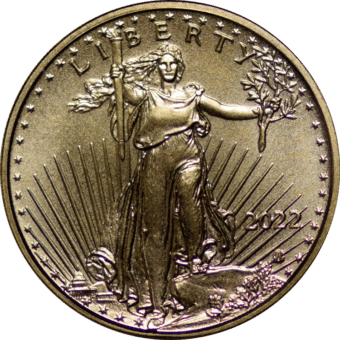

Is inflation truly under control? That question is once again front and center as wholesale prices accelerate, tariff battles intensify, and labor markets show signs of strain beneath the surface. January’s hotter-than-expected PPI report, renewed trade maneuvering following the Supreme Court ruling, and shifting employment dynamics tied to AI adoption all point to an economy navigating deeper structural pressures. While official narratives emphasize resilience, rising metals prices and persistent services inflation suggest the monetary story may be far from settled. In times like these, markets aren’t just reacting to data—they’re reassessing confidence in policy, currency stability, and long-term purchasing power.
Weekly Market Recap
Monday (2.23.26):
Gold and silver surged to start the week, holding near session highs as safe-haven demand strengthened. April gold climbed $139.30 to $5,220.00 (three-week high), while March silver advanced $4.48 to $86.81 (two-week high). The move followed weaker-than-expected U.S. factory orders (-0.7% vs. +0.2% expected), renewed U.S.–Iran tensions, and expanded tariff discussions. The dollar softened while oil firmed on concerns surrounding the Strait of Hormuz. The combination of trade developments, soft data, and geopolitical friction supported precious metals early in the week.
Tuesday (2.24.26):
Gold retraced modestly after reaching a three-week high overnight, with April futures down $63.40 to $5,162.00 as short-term positioning adjusted. Silver continued higher, gaining $1.142 to $87.765, reflecting persistent demand amid tariff uncertainty and renewed scrutiny of credit conditions. EU officials raised concerns about potential trade agreement violations, while commentary from major banking leadership highlighted caution in lending markets—factors that kept metals in focus.
Wednesday (2.25.26):
Midweek trading saw renewed strength in both metals, particularly silver. April gold added $37.40 to $5,214.50, and March silver rose $2.954 to $90.43, reaching a three-week high. Technical momentum improved, and safe-haven interest persisted against a complex geopolitical backdrop. However, remarks from Boston Fed President Susan Collins suggesting rates could remain elevated tempered upside enthusiasm.
Thursday (2.26.26):
Metals consolidated as markets digested earlier gains. April gold slipped $25.20 to $5,191.30, while March silver declined $4.238 to $86.81. A firmer U.S. dollar, crude oil near $66.50 per barrel, and a 10-year Treasury yield around 4.05% contributed to measured profit-taking. The pullback reflected repositioning rather than a fundamental shift in tone.
Friday (2.27.26):
Gold edged higher and silver strengthened in early U.S. trade ahead of January’s PPI release. April gold rose $8.40 to $5,202.30, while March silver gained $2.697 to $89.735. Markets anticipated headline and core PPI readings of +0.3% month over month. Meanwhile, U.S.–Iran nuclear talks showed incremental progress, and corporate restructuring in the technology sector highlighted ongoing labor-market adjustments tied to AI adoption.
Core wholesale prices jump more than expected in January
The big picture
Wholesale inflation accelerated in January, with core producer prices exceeding expectations. The data suggests upstream price pressures remain present, adding complexity to the Federal Reserve’s policy outlook.
Driving the news
Core PPI, excluding food and energy, rose 0.8% in January—well above the 0.3% estimate and December’s 0.6% increase. Headline PPI advanced 0.5%. Services prices climbed 0.8%, the largest gain since July 2025, while trade services rose 2.5%. Goods prices declined 0.3%, though core goods gained 0.7%. Metals prices increased 4.8%. Equity futures moved lower following the release, reflecting recalibrated inflation expectations.
By the numbers
- 0.8% — Core PPI monthly increase (vs. 0.3% expected)
• 0.5% — Headline PPI monthly increase (vs. 0.3% expected)
• 3.6% — Year-over-year core wholesale inflation
• 2.9% — Year-over-year headline wholesale inflation
• 0.8% — Monthly services price increase (largest since July 2025)
• 4.8% — Monthly rise in metals prices
• 2% — Federal Reserve inflation target
Why it matters
Persistent wholesale inflation suggests supply-chain and services pricing pressures have not fully subsided. With readings above the Fed’s 2% objective, policymakers may remain measured in adjusting rates. Tariff dynamics could further influence pricing trends in the months ahead.
What to watch
- Bond and equity market reaction
• Federal Reserve commentary
• Upcoming CPI data
• Evidence of tariff-related price adjustments
• Shifts in rate expectations
The bottom line
January’s PPI report indicates inflation moderation remains uneven. Markets may remain highly responsive to each incoming data point as expectations for policy adjustments evolve.
Trump boasts of a strong U.S. economy
The big picture
In his State of the Union address, President Trump emphasized economic strength and resilience, framing the U.S. economy as robust heading into the midterm cycle.
Driving the news
The speech centered on growth and price stabilization rather than previously discussed affordability measures such as a proposed 10% cap on credit card rates. While reiterating housing-related proposals, the broader message emphasized progress and attributed prior inflation to earlier policy choices.
By the numbers
- 10,600 — Word count of the address
• 10% — Previously proposed credit card rate cap
• 60% — Claimed drop in egg prices
• 56.6 — University of Michigan consumer sentiment reading
• 71.7 — Sentiment at inauguration
• 2022 — Year of peak inflation
Why it matters
Consumer sentiment remains below prior peaks, indicating a gap between official messaging and public perception. Legislative feasibility for affordability-focused policies may shape political dynamics in a narrowly divided Congress.
What to watch
- Congressional traction for affordability proposals
• Consumer sentiment trends
• Housing policy developments
• Executive actions on borrowing costs
• Public response to economic messaging
The bottom line
The administration presented a confident economic narrative. Whether that outlook aligns with household-level experience could influence the policy conversation ahead.
Trump trade chief vows to restore tariffs within months after SCOTUS ruling
The big picture
Following a Supreme Court ruling limiting emergency tariff authority, the administration signaled plans to reestablish trade measures through alternative statutory pathways.
Driving the news
In a 6–3 decision, the Court ruled against the use of IEEPA for broad tariff imposition. U.S. Trade Representative Jamieson Greer stated that authorities such as Section 301 and Section 232 remain viable options, potentially restoring tariffs—possibly at 15%—within months.
By the numbers
- 6–3 — Supreme Court vote
• 15% — Proposed global tariff rate
• 301 — Trade authority for unfair practices
• 232 — National security trade authority
• “Within months” — Stated timeline
Why it matters
While emergency authority was curtailed, established trade statutes remain available. The procedural requirements of these tools could influence timing and market expectations.
What to watch
- Launch of new trade investigations
• Legal responses to revised tariffs
• Congressional engagement
• International trade reactions
• Market response to tariff developments
The bottom line
Although the Court limited one pathway, tariff policy remains active. Trade measures will likely continue shaping global market conditions.
What the Trump–Supreme Court showdown means for precious metals markets
The big picture
The Court’s decision introduced fresh legal and policy uncertainty, a factor that often influences precious metals pricing dynamics.
Driving the news
After the IEEPA ruling, the administration pivoted to Section 122 of the Trade Act of 1974, initially implementing a 10% tariff before signaling 15%. The rapid transition left markets reassessing trade continuity and policy durability.
By the numbers
- 6–3 — Supreme Court vote
• 10% — Initial tariff under Section 122
• 15% — Revised rate
• Feb. 20 — Date of ruling
• 1974 — Trade Act origin
Why it matters
Gold often responds to periods of legal and geopolitical uncertainty. Shifting trade authorities can affect currency flows, confidence, and volatility. Markets will evaluate whether the transition stabilizes trade policy or prolongs ambiguity.
What to watch
- Legal developments tied to Section 122
• Responses from key trade partners
• U.S. dollar performance
• Equity volatility trends
• Prospects for negotiated trade outcomes
The bottom line
When policy frameworks evolve quickly, metals frequently reflect the adjustment process. The path of trade enforcement will remain relevant to gold and silver pricing.
Even banks now acknowledge gold’s structural role
The big picture
Following a record-setting 2025 in which gold posted 53 all-time highs and a 55% annual gain, major financial institutions are revising their long-term projections upward.
Driving the news
Gold’s advance has coincided with continued central bank accumulation, constrained physical inventories, and elevated global debt levels. Forecast revisions from large banks suggest a broader institutional reassessment of gold’s strategic role.
By the numbers
- 53 — All-time highs in 2025
• 55% — Annual gain
• $5,400 — Goldman Sachs 2026 projection
• $6,300 — JPMorgan 2026 base case
• $8,500 — JPMorgan upside scenario
• $354 trillion — Estimated global debt
• $38 trillion — U.S. sovereign debt
• 82 million ounces — COMEX silver inventories
• 5x — Increase in central bank gold purchases since 2022
• <1% — Average global portfolio gold allocation
Why it matters
Rising debt levels, monetary expansion, and sustained central bank purchases continue to shape long-term monetary conditions. Gold’s evolving perception as a reserve asset rather than a cyclical trade may influence broader capital allocation trends.
What to watch
- Central bank accumulation data
• Additional forecast revisions
• Monetary policy direction
• Physical inventory levels
• Allocation trends toward historical averages
The bottom line
Gold’s structural relevance is increasingly acknowledged across institutions. Long-term fundamentals remain central to its positioning within the global financial framework.
NEXT WEEK’S KEY EVENTS
Economic Calendar: March 2 – March 6, 2026 (ET)
MONDAY, March 2
• 9:45 am — S&P Final U.S. Manufacturing PMI (Feb.)
• 10:00 am — ISM Manufacturing (Feb.)
TUESDAY, March 3
• 9:55 am — New York Fed President John Williams Remarks
• 11:55 am — Minneapolis Fed President Neel Kashkari Interview
WEDNESDAY, March 4
• 8:15 am — ADP Employment (Feb.)
• 9:45 am — S&P Final U.S. Services PMI (Feb.)
• 10:00 am — ISM Services (Feb.)
THURSDAY, March 5
• 8:30 am — Initial Jobless Claims (Feb. 28)
FRIDAY, March 6
• 8:30 am — Jobs Report (Employment Situation Summary) (Feb.)
• 1:30 pm — Cleveland Fed President Beth Hammack Speaks
IMPACT ON PRECIOUS METALS MARKETS
Manufacturing & Services PMIs / ISM Data
• Stronger growth and firm price components → may support higher-rate expectations; potentially neutral to modestly negative for metals.
• Softer activity or cooling prices → may reinforce easing expectations; potentially supportive for metals.
Federal Reserve Speakers
• Hawkish guidance → may anchor yields higher; headwind for gold and silver.
• Dovish tone → may ease policy expectations; supportive for metals.
ADP & Jobless Claims
• Labor resilience → supports tighter policy narrative; modestly negative for metals.
• Signs of softening → may bolster easing expectations; supportive for metals.
Jobs Report (Friday)
• Strong payrolls and wage growth → reinforces restrictive policy outlook; may pressure metals.
• Softer employment and wages → strengthens case for rate adjustments; supportive for metals.
The employment report remains the week’s defining release, often driving significant short-term volatility across currencies, yields, equities, and precious metals.
Continue the Conversation
Market conditions are evolving quickly, and understanding the intersection of inflation, trade policy, and monetary direction is essential for those focused on long-term purchasing power.
To explore deeper analysis, precious metals education, and timely market updates, we invite you to continue learning at Prime Assets. Stay informed, stay prepared, and stay grounded in strategies built for enduring value.